
How to Calm Your Mind in 5 Minutes
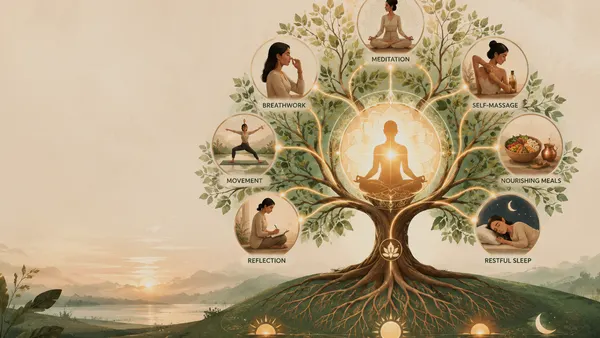
Five breath and body practices a doctor actually prescribes — what each one does, exactly how to do it, how long it takes, and which to reach for in which situation. No apps, no equipment, no belief required.
Insights & Perspectives
Reflections on Ayurvedic psychiatry, mental wellness, and the everyday practices that support a balanced mind and body.
Five breath and body practices a doctor actually prescribes — what each one does, exactly how to do it, how long it takes, and which to reach for in which situation. No apps, no equipment, no belief required.
Anxiety is an alarm system doing its job at the wrong volume — not a weakness, and not a character flaw. What it is, why it lands in the body first, how Ayurveda reads it, what genuinely settles it, and when it deserves more than self-help.
The most common sentence I hear about meditation is that it doesn't work — the mind keeps wandering. That wandering isn't failure. It's the entire exercise, and here's how to practise it properly in three minutes a day.
Most evening routines are written for homes that don't look like ours — dinner at 6pm, silent houses, nobody else's schedule to work around. Here is a realistic five-anchor evening for Indian homes, with the timings that actually matter.
Infopark, Technopark, the 9pm client call, the Sunday dread. Burnout in Kerala's tech workforce has a recognisable shape — and a phased way back that doesn't require quitting your job.
You've been tired since 4pm. Now it's midnight and your mind is wide awake. Here's what 'tired but wired' actually is, why the exhaustion and the alertness aren't a contradiction, and the evening protocol that unwinds it.
Short answer: NSDR is yoga nidra renamed — but one element gets dropped, and it matters. A doctor explains what's the same, what's genuinely different, what the science really shows, and which to practise tonight.
A practical Ayurvedic guide to rebuilding Ojas — the vital essence behind immunity, energy and a steady mind. Nine gentle, everyday ways to restore what stress, poor sleep and overwork quietly drain.
Yoga Nidra — 'yogic sleep' — is a guided practice of conscious relaxation that calms the nervous system, eases anxiety and restores deep rest. Here is how it works and how to begin.
PCOS has been renamed PMOS — polyendocrine metabolic ovarian syndrome — to reflect that it shapes mood, sleep and metabolism, not just the ovaries. Here is the mind-body link, through an Ayurvedic lens.
Centuries before modern psychology, Ayurveda described Sattvavajaya Chikitsa — healing the mind by gently guiding it back toward clarity. Here is what it means and how it helps today.
Ojas is Ayurveda's vital essence — the foundation of immunity, vitality, and mental stability, formed from the complete transformation of nourishment.
You slept a full night and woke up exhausted anyway. Ayurveda's answer: duration isn't restoration. The four causes of unrefreshing sleep, a morning self-test to find yours, and a two-week reset.
When the body and mind are stretched too thin, Ayurveda points to Vata imbalance. Five signs your system is asking for support — and what they mean.
Waking at 3am with a racing mind has a precise explanation — in Ayurveda's map of the night and in your own cortisol and sleep architecture. Why it happens, what the hour means, what to do at 3am itself, and how to set up the night so it holds.
Struggling with sleep? Ayurveda identifies why insomnia happens based on your dosha and offers root-level approaches to restore deep, natural rest.
Burnout is more than exhaustion — a deep depletion of life force. Ayurveda explains why it happens, why it lingers, and how to rebuild.
Discover how Triguna Siddhanta — Sattva, Rajas, and Tamas — explains mental balance in Ayurvedic psychiatry. A guide by Dr. Amruthavani.
Explore the Ayurvedic concept of Manas (mind) and how it shapes perception, memory, and mental health. By Dr. Amruthavani, Ayurvedic Psychiatrist.
Learn how Ayurveda explains stress through dosha imbalance and how Ayurvedic psychiatry addresses emotional strain at its root.
Ayurveda explains why multitasking is a cognitive illusion. Dr. Amruthavani explores Ayurvedic insights on perception and mental focus.
Vata, Pitta, or Kapha — your dosha is your unique mental and physical blueprint. Learn what each dosha means for how you think, feel, and respond to stress.
In Ayurveda, the gut and the mind have never been separate. Explore how Agni, Ama, and Sadhaka Pitta explain the deep connection between digestion and emotional wellbeing.
Dinacharya is Ayurveda's complete framework for structuring the entire day — from waking to sleep — in alignment with natural rhythms and mental wellbeing.
Manas Notes
One reflection, one gentle practice, and one worthwhile read on Ayurvedic mental wellness — from Dr. Amruthavani. No spam, unsubscribe anytime.
By subscribing, you agree to receive occasional emails from Dr. Amruthavani. Unsubscribe anytime.