
The Inner Mirror: What Ayurveda Means by Swastha
Ayurveda defines health as swastha — balanced doshas and digestion, and a self, senses and mind that are clear and pleasant. Not merely the absence of disease. A reflection on clarity, and on the mirror through which we see our lives.
In short
Sushruta defines a healthy person — swastha — as one whose doshas, digestion, tissues and elimination are in balance, and whose self, senses and mind are clear and pleasant. Health is therefore a state of clarity, not merely the absence of disease. The mind works like a mirror: experience, fear and old belief settle on it like dust, and what we see is shaped as much by the surface as by what stands before it.
समदोषः समाग्निश्च समधातुमलक्रियः । प्रसन्नात्मेन्द्रियमनाः स्वस्थ इत्यभिधीयते ॥
Samadoṣaḥ samāgniśca samadhātumalakriyaḥ | Prasannātmendriyamanāḥ svastha ityabhidhīyate ||
— Sushruta Samhita, Sūtrasthāna
This verse offers a remarkably complete understanding of health. A person is described as swastha — literally, established in oneself — when the doshas are in balance, when digestion and metabolism function properly, when the tissues and the processes of elimination are balanced, and when the self, the senses and the mind rest in a state of clarity and pleasantness.
Read that last clause again, because it is easy to hurry past. The state of the mind is not an addition to the definition of health. It is part of it.
In other words: health is not merely the absence of disease. It is a state of balance, awareness and clarity.
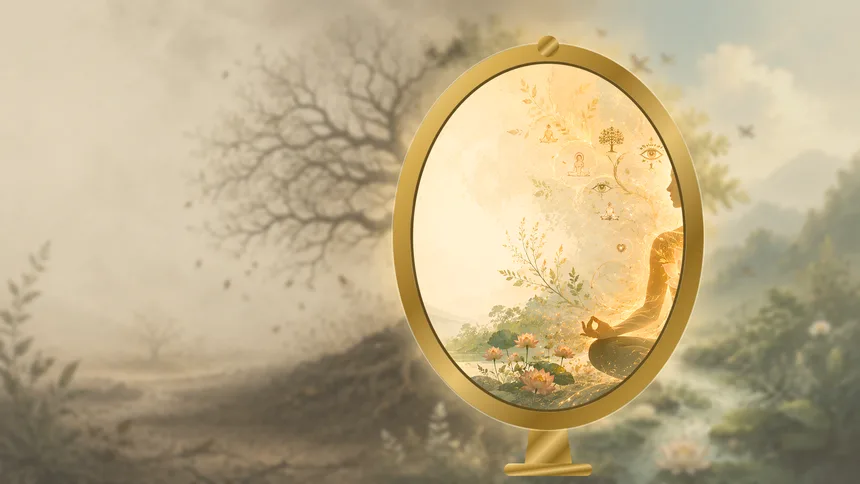
And perhaps a simple object helps us understand this better: a mirror.
What happens when a mirror is dirty
A mirror is designed to reflect. But when its surface is covered with dust or stains, the reflection becomes unclear.
The person standing in front of it has not changed. The mirror has.
Something similar happens within us. Our experiences, fears, unresolved emotions, assumptions and habitual patterns shape the way we perceive ourselves, other people and the situations around us. The external world may be unchanged, while our interpretation of it shifts entirely.
A person who has repeatedly experienced rejection may begin to expect rejection, even where there is no present evidence of it. Someone who has been criticised often may begin to see themselves as inadequate. Someone who has lived with prolonged fear may read neutral situations as threatening.
The mind becomes a kind of inner mirror through which we experience life.
And sometimes, before trying to change what we see, it is worth examining the condition of the mirror.
A clear mirror does not flatter you
There is something else we forget about a good mirror.
A clear mirror never flatters your image. It doesn’t make you look better than you are. It doesn’t hide the small imperfections, the tiredness, the expressions you may not like. It simply reflects what is there.
And that is precisely what makes it useful.
When you look into a clear mirror you may notice something you’d rather not. Perhaps you look tired. Perhaps there is an expression on your face that tells you something about how you are actually feeling.
The mirror doesn’t insult you. It gives you information. And information gives you a choice. You can ignore what you see, or you can decide to do something about it.
The same principle applies to psychological self-awareness. A clear inner mirror does not necessarily show us a flattering picture. It may reveal our impatience, our defensiveness, our jealousy, our fears, our unresolved emotions, our unhealthy patterns.
But seeing these things clearly is not a failure. Seeing is where change begins — because we cannot work on what we refuse to look at.
Clarity is not a luxury
We tend to think of clarity as desirable but optional. It isn’t. It is a requirement for living well.
Physical clarity means paying attention to the body — its signals, its needs, its nourishment, movement, sleep and rhythms.
Psychological clarity means becoming aware of our thoughts, emotions, beliefs, reactions and patterns of behaviour.
Clarity of values means understanding what actually matters to us, and what our life is oriented toward.
These are not separate compartments. They act on one another constantly. When the body is exhausted, the mind becomes less resilient — the physical signals of a strained nervous system are often the first honest report we get. When the mind is overwhelmed, physical functioning and daily habits suffer. And when we lose connection with our values, even external success can fail to produce any sense of fulfilment.
This is why swastha is a far broader idea than being free of illness. It points toward integrated wellbeing — and it is the same understanding that sits underneath Ayurveda’s view of the mind itself.
But who is responsible for cleaning the mirror?
Here the metaphor becomes genuinely interesting.
We cannot control the environment around us. People may criticise us. Circumstances may disappoint us. We will encounter stress, conflict, loss and uncertainty.
In other words: dust will fall on the mirror. That is not in question.
The question is whether we are willing to notice it, and to clean it.
This is not about blaming ourselves for everything that happens to us. It is about recognising the part that lies within our influence. We can learn to observe our reactions. We can question beliefs that no longer serve us. We can process unresolved experiences, build steadier habits, create boundaries around what repeatedly disturbs us, and ask for support when we need it.
And we can return to ourselves, again and again.
We cannot prevent every impurity from touching us
Life leaves something on all of us. A difficult conversation. A painful memory. A failure, a criticism, a stressful workplace, a relationship conflict, an unexpected change.
Some of it is unavoidable. But an experience entering our life does not mean it must permanently become part of our identity.
What happens to us is one thing. What we make of what happens to us is another.
Psychological growth often begins in the space between the event and our response to it. We pause. We observe. And we ask:
- Is this really who I am?
- Is this belief still true?
- Am I responding to what is happening now — or to something that happened long ago?
- Is my perception clear, or is something colouring the reflection?
That pause is where clarity becomes possible. It is also, in essence, what sattvavajaya — Ayurveda’s psychological therapy — works with.
The mirror of the self
There is a beautiful connection here with Sree Narayana Guru, who once consecrated a mirror in place of an idol — inviting the worshipper to look not outward, but inward.
The symbolism is difficult to improve upon. Instead of endlessly searching outside ourselves, we are asked to see. Not to admire the reflection. Not to judge it. Simply to see.
Psychological self-awareness begins the same way. We observe our thoughts without immediately becoming them. We observe our emotions without letting each one dictate our actions. We observe our patterns without rushing to condemn ourselves for them.
The purpose of looking into the inner mirror is not self-criticism. It is self-understanding.
Clean the mirror, not the world
We spend enormous energy trying to change other people. We want colleagues to behave differently, partners to understand us, children to listen, circumstances to become easier.
The world, however, will never be entirely free of dust.
So perhaps a more useful question is: what can I clean within myself?
Can I clear an old assumption? Can I process an unresolved emotion? Can I release a belief that no longer represents who I am? Can I take better care of my body, create healthier boundaries, reconnect with my values? Can I make my mind a little clearer today than it was yesterday?
Living well is a continuous process
A clean mirror does not stay clean forever. Neither does the mind.
Clarity is not something achieved once and kept permanently. It is something practised. We observe. We reflect. We adjust. We clean. We begin again. A steady daily rhythm is, in a sense, simply the habit of cleaning regularly rather than waiting until we can no longer see.
Perhaps this is one way to understand holistic wellbeing:
Take care of the body. Understand the mind. Clarify your values. Protect your inner space. And learn to distinguish what belongs to you from what has merely fallen upon you.
Because life will continue to bring both beauty and dust. We may not control everything that touches us — but we can learn to keep returning to clarity.
And perhaps that is what swastha truly points to: not simply the absence of disease, but an ongoing movement toward balance, awareness and inner wellbeing.
A clear mirror does not show you a perfect image. It shows you an honest one. And an honest reflection gives you something powerful: the opportunity to improve.
The world may not always give us a clear reflection. But we can choose to keep cleaning the mirror through which we see it.
Clarity is not a luxury. It is a requirement for living well.
If you’d like a small, structured look into your own mirror, the free Manas Prakriti check takes two minutes — five questions from classical Ayurvedic tradition on whether sattva, rajas or tamas is leading your mind right now.
A note on what this is: This article is a reflection on Ayurvedic philosophy and self-awareness — it is not a diagnosis, a treatment plan, or a substitute for individual medical care. If you have been carrying something difficult for a long while, please speak with a qualified clinician. In India, free confidential support is available through Tele-MANAS at 14416 and iCall at 9152987821.
Frequently asked questions
What does swastha mean in Ayurveda?
Swastha literally means 'established in oneself'. Sushruta defines it as a person whose doshas are in balance, whose digestive fire and metabolism function properly, whose tissues and elimination processes are balanced, and whose self, senses and mind are clear and pleasant. It describes a state of integrated wellbeing rather than simply a body without illness.
What is the Sushruta Samhita definition of health?
The verse Samadoṣaḥ samāgniśca samadhātumalakriyaḥ, prasannātmendriyamanāḥ svastha ityabhidhīyate lists four conditions: balanced doshas; balanced agni, the digestive and metabolic fire; balanced tissues and waste elimination; and a self, senses and mind in a state of clarity and pleasantness. Notably, the mental clause is not an afterthought — it is part of the definition itself.
Is health really more than the absence of disease?
In this framework, yes. A person can have no diagnosable illness and still be exhausted, unclear, irritable or disconnected from any sense of meaning. Ayurveda's definition treats clarity and pleasantness of mind as a requirement of health, not a bonus on top of it — which is why the absence of disease alone is an incomplete measure.
What does the mirror symbolise in this context?
The mind functions like a mirror through which we perceive ourselves and others. Experiences, fears, unresolved emotions and long-held beliefs settle on that surface like dust, so what we see is shaped partly by the world and partly by the state of the mirror. Someone repeatedly criticised may come to see themselves as inadequate even where there is no present evidence for it.
How do I begin developing this kind of self-awareness?
Begin with noticing rather than fixing. When a strong reaction arrives, pause long enough to ask whether you are responding to what is happening now or to something older. Observe thoughts without immediately becoming them, and emotions without letting each one dictate action. The aim is self-understanding, not self-criticism — and because clarity is not achieved once and kept, it is a practice you return to rather than a state you reach.