
An Ayurvedic Evening Routine for Deep Sleep
Most evening routines are written for homes that don't look like ours — dinner at 6pm, silent houses, nobody else's schedule to work around. Here is a realistic five-anchor evening for Indian homes, with the timings that actually matter.
In short
A good night is built in the three hours before it, not in bed. The five anchors that matter most: dinner finished about three hours before sleep and lighter than lunch, lights lowered and warmed from around 8:30pm, a three-minute warm-oil foot massage, two minutes closing the day on paper, and bed inside the kapha window before 10:30pm. Choose two to start — routines fail from ambition, not from lack of willpower.
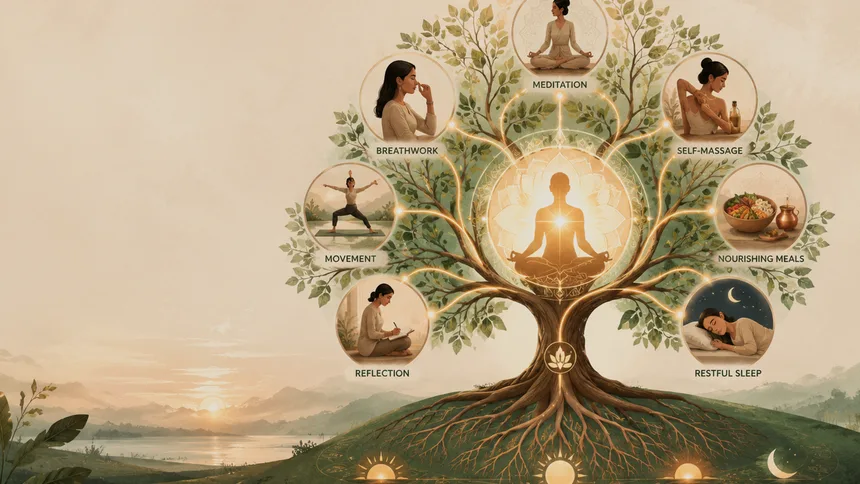
Almost every evening routine you’ll read was written for a house that looks nothing like ours. Dinner at six. A quiet home by eight. Nobody else’s timetable to work around, no one arriving late from work, no serial playing in the next room, no child who suddenly remembers homework at 9:15pm.
Then we’re told to take a warm bath, journal for twenty minutes, and read poetry by candlelight.
So let me offer something different: five anchors that work in an actual Indian home, in the order of how much difference they make. You don’t need all five. Two done nightly will change your sleep more than five attempted twice.
Why the evening matters more than the bed
Here is the principle underneath everything below: a nervous system running hot at 10pm cannot be commanded to stop at 10:30pm.
Sleep is not something you do at bedtime. It is something the body arrives at, if the last three hours have been pointing that way. Ayurveda organises this beautifully — the evening belongs to kapha (roughly 6–10pm), whose qualities are heavy, slow and settling. That is the body’s own tide toward rest. Go to bed inside it and you fall asleep on the tide. Push past it into pitta time (10pm–2am), the transformation hours, and you often catch a second wind and find yourself wide awake at midnight, wondering where the sleepiness went.
That’s the whole game: land inside the kapha window, and do the three hours before it in a way that lets the body slow down.
Anchor 1 — Dinner: earlier and lighter (the one that matters most)
If you change nothing else, change this.
Finish dinner about three hours before you sleep, and keep it lighter than lunch. For an 11pm sleeper, that means eating by 8pm.
The reason is specific. The pitta watch (10pm–2am) is when the body does its deepest repair — but only if it isn’t busy digesting. Eat heavily at 9:30 and sleep at 11, and the body finishes the meal somewhere around 2–3am, metabolic activity rises, and you surface. This single factor explains more 3am waking than anything else I see.
When dinner genuinely can’t move, which is most homes:
- Shift the weight of the day earlier. Make lunch the largest meal — digestive capacity is strongest at midday and weakest late at night. The common pattern of a token lunch at the desk and a heavy 10pm dinner is precisely backwards.
- Eat the late meal deliberately small. A bowl of rice and dal, a vegetable stew, curd rice at room temperature. You can sit with the family and eat lightly; that’s a solved problem.
- Favour warm, soft, moist food over salads, raw vegetables or anything cold from the fridge. Vata is aggravated by cold, dry and light foods — exactly the “healthy dinner” many tired professionals reach for.
Anchor 2 — Lower the light from 8:30pm
Not screens yet. Light itself.
Indian homes are lit brightly and from overhead — tube lights and white LEDs that read to the body as midday. From about 8:30pm, switch off overhead lights in the room you’re sitting in and use one lamp, low and warm. If the household needs the main light on, move yourself: sit where a table lamp is enough.
This costs nothing and no one has to agree to it. It’s the single easiest anchor to keep.
Anchor 3 — The digital sunset, built in seven days
An hour before bed, screens away. Everyone knows this; almost nobody does it. So make it a location rule, not a willpower rule: the phone charges in another room from 9pm. Not face-down beside you — another room. Willpower is the resource you have least of at 9pm; distance works when discipline doesn’t.
If a full hour feels impossible, build it over a week:
| Nights | Screens off before bed |
|---|---|
| 1–2 | 15 minutes |
| 3–4 | 30 minutes |
| 5–6 | 45 minutes |
| 7 onward | 60 minutes |
And a realistic note: the goal is the last hour, not the whole evening. Watch the serial. Take the call. Just let the final hour belong to something dimmer.
Anchor 4 — Padabhyanga: warm oil on the feet
Three minutes, and the practice patients most often thank me for.
Warm a little sesame oil by standing the bottle in hot water for a minute. Sitting on the edge of the bed, work the sole of each foot with your thumb for three to four minutes — slow circles from heel to the base of the toes — then the ankles, then each toe. Wipe with an old towel kept for the purpose and put on cotton socks.
Two things happen. Warm oil directly counters vata’s cold, dry, mobile quality at the coldest point of the body. And the slow, repetitive contact pulls attention downward and outward — away from a head full of thoughts. On especially restless nights, a ten-minute warm foot soak, ankle-deep, water as warm as is comfortable, does similar work.
This is also the anchor that survives a chaotic household best. It takes three minutes, in your own room, in silence.
Anchor 5 — Close the day on paper (two minutes)
The mind treats unfinished things as open files, and reopens them when sleep gets light. You don’t need to resolve anything — research on unfinished tasks suggests the intrusive quality fades once there’s a written plan for continuing.
Three lines in a notebook — a paper one, kept by the bed:
- What actually happened today (one line, no judgement).
- What is still undecided.
- Tomorrow’s first step — the very first physical action, not the goal.
Two minutes. The mind lets go of what it knows is written down. This is the anchor that helps most if your problem is a racing mind rather than a restless body — and if that’s you, the pattern is worth reading about properly: tired but wired.
Then: bed inside the kapha window
In bed by about 10:30pm, so you enter deep sleep on schedule rather than pushing it into the small hours. If that sounds impossibly early, move it fifteen minutes a week rather than an hour at once.
If you’re not asleep after what feels like twenty minutes, get up and sit somewhere dim with a physical book until drowsiness returns. Lying in bed straining toward sleep teaches your mind that bed is a place of effort and failure — that association becomes its own obstacle.
The Kerala evening: three local realities
- Monsoon humidity makes heavy, oily, fried food sit badly at night. In the wet months, keep dinner especially light and warm — a thin stew or kanji is more useful than it looks.
- Heat delays sleep onset because the body needs its core temperature to drop. A lukewarm shower — not cold — about an hour before bed helps: the body rebounds into a cooling phase afterwards.
- Mosquito coils and repellents burned in a closed bedroom irritate the airway and fragment sleep for some people. If you use them, light them early and air the room before you sleep.
Start with two
The failure mode of every routine is ambition. People adopt all five anchors on the same Monday and abandon them by the second week.
Pick two: dinner timing plus one other — the foot oil if your body won’t settle, the paper close if your mind won’t. Hold those two for two weeks until they’re automatic. Then add a third.
Most people notice easier sleep onset within seven to ten nights. Depth and morning freshness take three to four weeks — you are re-teaching a rhythm, and rhythms move slowly. The whole day this rests on is worth understanding too: dinacharya, the Ayurvedic daily rhythm.
Not sure which sleep pattern is yours — trouble falling asleep, waking in the night, or waking unrefreshed? The free sleep check takes two minutes and points you to the pattern that matches your nights.
A note on what this is: This article is general education about sleep and Ayurvedic principles — it is not a diagnosis, a treatment plan, or a substitute for individual medical care. If your sleep has been difficult for a long stretch, please speak with a qualified clinician. In India, free confidential support is available through Tele-MANAS at 14416 and iCall at 9152987821.
Frequently asked questions
What time should I eat dinner for better sleep?
About three hours before you sleep, and lighter than your midday meal — for an 11pm sleeper that means finishing by 8pm. Digestion and settling compete for the same resources, so a heavy late meal keeps the system working when it should be winding down. If family dinner genuinely cannot move earlier, keep the late meal deliberately light and take your larger meal at midday instead.
Does the warm oil foot massage really help sleep?
It is the practice patients most often come back and thank me for. Three to four minutes per foot with slightly warmed sesame oil, working the sole with your thumb, then ankles and toes. It does two things: warm oil directly counters vata's cold, dry, mobile quality at the point where the body is coldest, and the slow repetitive contact pulls attention downward, away from a head full of thoughts.
How do I keep an evening routine in a joint family or a noisy house?
Don't try to change the household — change your own last hour inside it. The five anchors are all things you can do while a television is on in the next room: your own dinner timing and portion, a lamp instead of the tube light where you sit, foot oil in your room, three lines in a notebook, and your own bedtime. A routine that depends on everyone else cooperating will not survive the week.
How long before an evening routine improves my sleep?
Most people notice easier sleep onset within seven to ten nights of consistency — you are re-teaching a rhythm rather than fixing one night. Depth of sleep and morning freshness usually follow later, over three to four weeks. Doing two anchors every night beats doing all five for three nights and then stopping.
What if I work night shifts or US hours?
The principle is rhythm, not clock time. Build the same five anchors around your own sleep window — a light meal three hours before you sleep, dimmed light in the hour before, the foot massage, the paper close, and a consistent time you get into bed. What damages sleep most is the schedule shifting from day to day, not the hour itself.